Canada recruits dozen of US scholars — including several science stars
📌 概要
Canada has lured 48 scholars away from the United States with a talent recruitment initiative. Credit: tobiasjo/Getty As Canada and the United States battle over tariffs, Canada has notched a victory
⚡ 关键要点
- ▸Canada has lured 48 scholars away from the United States wit
- ▸Enjoying our latest content?
- ▸Log in or create an account to continue
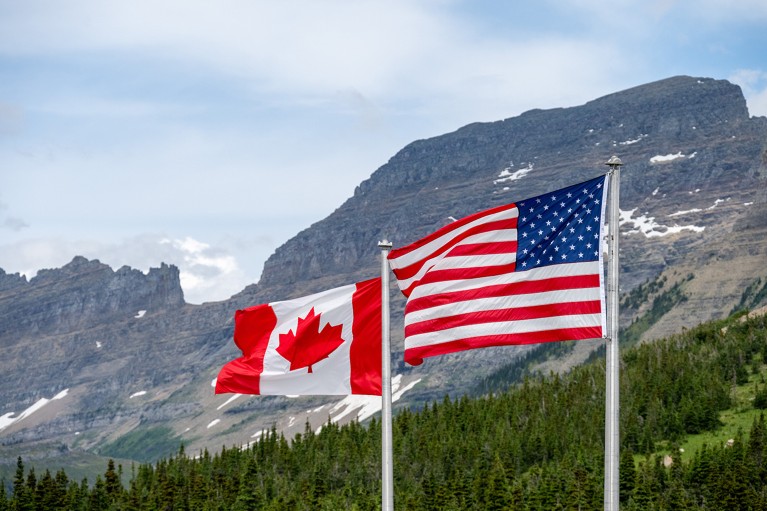
Canada has lured 48 scholars away from the United States with a talent recruitment initiative. Credit: tobiasjo/Getty
As Canada and the United States battle over tariffs, Canada has notched a victory for its scientific workforce. On 27 August, the government announced that Canadian universities had recruited 64 researchers from around the world as part of a campaign to attract foreign talent — and that 48 of them were moving from the United States.
How China is vying to attract the world’s top scientific talent
The goal of the initiative is to “pursue ambitious research in fields critical to Canada’s prosperity, sovereignty, health and resilience”, the announcement said. The incoming scientists will receive a total of 500 million Canadian dollars (about US$360 million) in funding for eight years as part of the Eddie Goldenberg Research Chairs of Canada and Canada Impact+ Emerging Leaders programme, the centerpiece of a broader effort to attract foreign talent launched in December.
Canada is just one of a number of nations vying to attract foreign talent. Many spy an opportunity in particular to poach researchers from the United States as the administration of US President Donald Trump attempts to cut funds for research grants and exert control over US universities. Earlier this year, France recruited 41 researchers based in the United States through its Choose France for Science programme, and Nobel-prize-winning chemist Omar Yaghi retired from the University of California, Berkeley, and took a full-time position at Tsinghua University in Beijing, China.
US funding uncertainty was a key decision-making factor for several of the researchers who were successful in applying to Canada’s programme. Phillip Zamore, who is chair of the RNA Therapeutics Institute at the University of Massachusetts Chan Medical School in Worcester, is moving to McGill University in Montreal. One of his research grants from the US National Institutes of Health (NIH) was left without a funding decision for 18 months — an unusually long time. “I had to shrink my lab,” he says. Some people left, and he couldn’t replace them, he says, because “I didn’t know if I’d have the money”. Zamore will receive one of the highest levels of funding from the Canadian programme: US$1.1 million annually.
“At a time when parts of the world are turning away from science, Canada is doubling down,” said Mélanie Joly, Canada’s minister of industry, when announcing the recruits.
This US brain drain was “entirely predictable”, given the Trump administration’s policies, says Michael Lubell, a physicist who tracks science policy at the City College of New York. “This is only the beginning,” he adds.
The White House Office of Science and Technology Policy did not respond to Nature’s request for comment.
Brain drain
The 48 US-based researchers heading for Canada work in the fields of health, biotechnology, engineering, physics, climate and environmental science and the social sciences. They are relocating to 21 Canadian universities, including some of the nation’s best-known institutions, such as McGill University, the University of British Columbia in Vancouver and the University of Toronto.

Dozens of researchers will move to France from US following high-profile bid to lure talent
In the United States, the University of Michigan in Ann Arbor is losing the most scholars: three researchers working in the fields of engineering and sustainability. (The University of Michigan did not respond to Nature’s request for comment.) Harvard University and the Massachusetts Institute of Technology (MIT), both in Cambridge, are each losing two researchers.
The number of US scholars going to Canada is small relative to the size of the US scientific workforce. But many of those leaving are leading researchers in their fields, Lubell says. Their departures could act as an accelerant, encouraging others to consider opportunities abroad.
In several cases, graduate students, postdoctoral researchers and other members of the researchers’ teams are also going with them, potentially extending the effects of the brain drain to the next generation of scientists. “I have at least one graduate student, two postdocs and a lab manager who are going to move with me,” Zamore confirms.
“I do think current policy is a cause for concern and could eventually lead to more departures,” says Megan MacGarvie, an economist at Boston University’s Questrom School of Business in Massachusetts.
Enjoying our latest content?
Log in or create an account to continue
- Access the most recent journalism from Nature's award-winning team
- Explore the latest features & opinion covering groundbreaking research
or
Sign in or create an account Continue with Google
 Continue with ORCiD